The AI Hype Cycle: Why Every New Tool Promises Revolution and Delivers Evolution
Every few months, a new AI tool drops and the tech world loses its collective mind.
“This changes everything.”
“Developers/designers/marketers are obsolete.”
“We’re witnessing the future.”
Then reality sets in. The tool is useful. Sometimes very useful. But it didn’t actually replace anyone. It made the good ones faster and exposed the mediocre ones who thought tools were a substitute for skill.
We’ve seen this pattern repeat so many times now that it’s become predictable. Yet every cycle, the same breathless predictions emerge.
Let me walk you through what actually happens.
The Pattern That Keeps Repeating
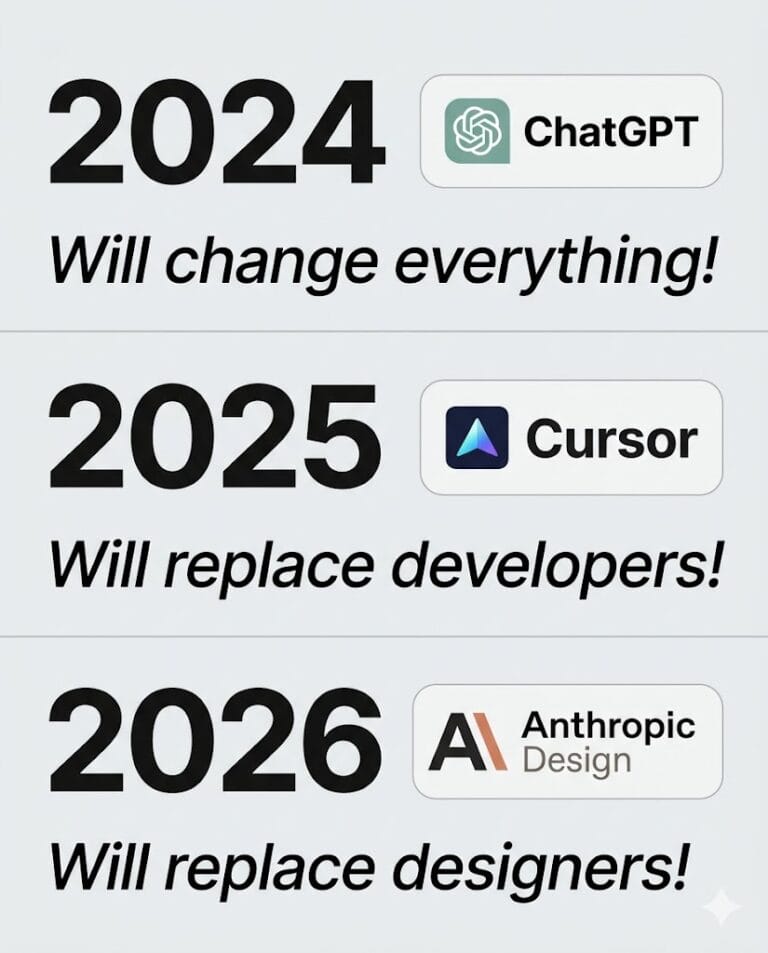
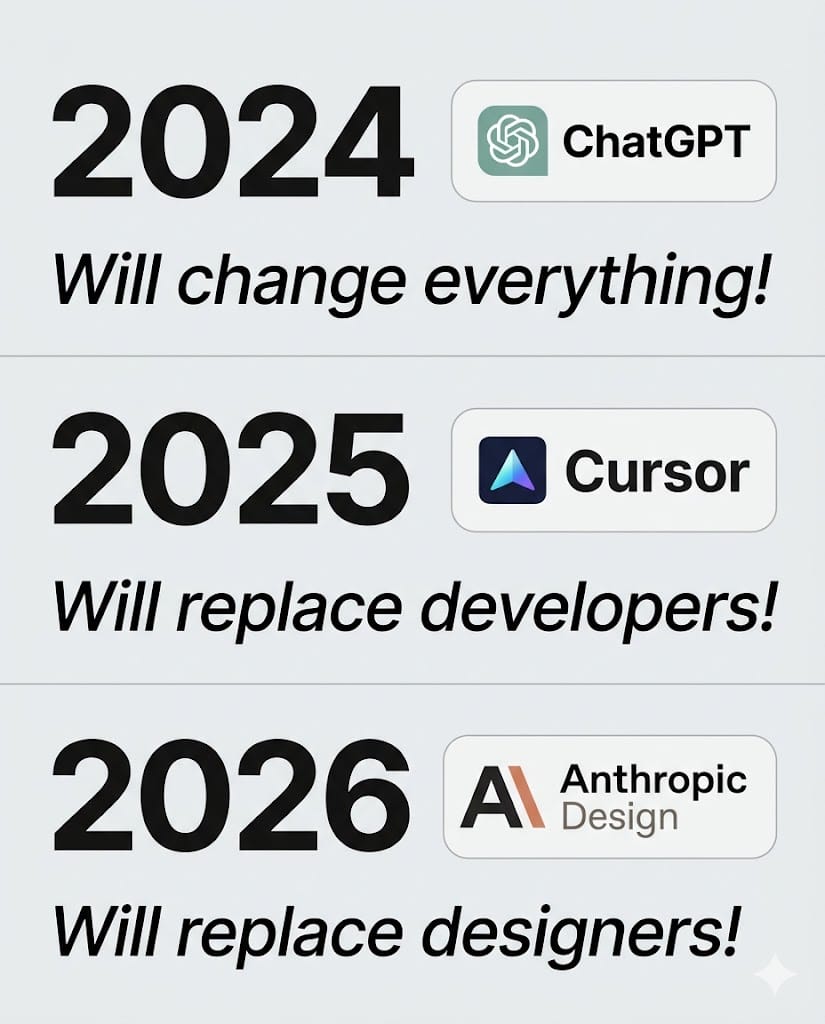
2024: “ChatGPT is going to change everything!”
Result: We’re still writing code, just faster.
2025: “Cursor is going to replace developers!”
Result: We’re still writing code, just faster.
2026: “Claude Design is going to replace designers!”
Result: … you see where this is going.
This isn’t cynicism. These tools genuinely are useful. ChatGPT did accelerate how we draft documentation and explore technical concepts. Cursor legitimately sped up boilerplate code generation. Claude Design (and tools like it) will almost certainly help with rapid prototyping and design exploration.
But none of them replaced the human making the decisions.
Why The Hype Cycle Exists
There are good reasons why every AI tool launch follows this pattern:
1. Demo Magic vs. Production Reality
Tool demos are designed to show best-case scenarios. Clean inputs, clear objectives, simple constraints. Real projects are messy. Requirements change mid-stream. Stakeholders have conflicting visions. Edge cases multiply faster than you can document them.
AI tools excel at the demo. They struggle with the mess.
When Claude Design generates a beautiful landing page from a prompt, that’s impressive. When your client sends feedback like “make it pop more” or “can we try it in teal?” — that still requires a human who understands both design principles and client communication.
2. The Skill Gap Becomes More Visible
Every new AI tool does the same thing: it raises the floor and raises the ceiling.
Raising the floor means someone with basic skills can now produce work that looks more professional. A founder with no design background can generate decent mockups. A junior developer can scaffold out architecture they don’t fully understand yet.
Raising the ceiling means experts can move faster and explore more options. A senior designer can iterate through ten variations in the time it used to take for three. An experienced developer can prototype complex systems and focus energy on the novel problems rather than boilerplate.
The gap between “using the tool” and “using the tool effectively” gets wider, not narrower. The AI makes the skilled more productive. It makes the unskilled more dangerous.
3. Process Problems Don’t Get Solved By Better Tools
We’ve watched agencies pivot to “AI-first workflows” only to discover that their actual bottleneck wasn’t the design phase — it was client feedback cycles, unclear requirements, and stakeholders who couldn’t articulate what they wanted.
New tools don’t fix broken processes. They just give you new excuses when projects still take too long.
The team that was slow with Figma is usually slow with Claude Design too. Because the tool was never the constraint.
What Actually Happens After The Hype
Give it six months after any major AI tool launch and you’ll see the same progression:
Week 1-2: Peak Hype
Twitter/LinkedIn explodes with “this changes everything” takes. Early adopters share impressive demos. Think pieces about the death of [insert profession here] go viral.
Week 3-4: Reality Check
People actually try to use it on real projects. Limitations emerge. Edge cases break things. Someone shares a thread about why it’s “not ready for production.”
Month 2-3: Trough of Disillusionment
The backlash cycle begins. “We tried it and went back to [old tool].” Stories about AI failures get shared. Pendulum swings from “it’s magic” to “it’s useless.”
Month 4-6: Plateau of Productivity
The hype dies down. People figure out what the tool is actually good for. It finds its place in workflows without replacing entire roles. Useful, not revolutionary.
This is where we are with ChatGPT now. This is where we’ll be with Cursor. This is where we’ll end up with Claude Design.
And that’s fine. Useful is valuable.
The Real Value Proposition
Here’s what these AI tools actually do:
They Accelerate Exploration
Want to try ten different layout approaches? AI can generate variations faster than you can sketch them. Want to explore multiple technical architectures? AI can scaffold options for comparison.
This is genuinely useful. The ability to explore more of the solution space in less time leads to better outcomes — if you have the judgment to evaluate what you’re seeing.
They Handle Boilerplate
Repetitive code. Standard layouts. Common patterns. AI tools are excellent at generating the scaffolding that humans find tedious.
This frees up mental energy for the novel problems. The parts that actually require creativity and judgment.
They Lower The Barrier To Experimentation
Junior developers can explore patterns they haven’t mastered yet. Founders can prototype ideas before hiring designers. Teams can test concepts without committing significant resources.
This is democratizing in the best sense — it gives more people access to tools that help them think.
But — and this is critical — it doesn’t replace the need to learn the underlying principles.
Why Human Judgment Still Matters
AI tools are incredible pattern matchers. They’ve seen millions of examples and can generate outputs that follow established conventions.
What they can’t do (yet) is understand context beyond what you explicitly tell them.
The Questions AI Can’t Answer
- Is this design appropriate for our specific audience?
- Does this technical architecture align with our business constraints?
- Will this messaging resonate with customers who have specific pain points?
- Which of these ten options will best serve our goals six months from now?
These require judgment developed through experience, context awareness, and understanding of business goals that extend beyond the immediate task.
The founder who uses Claude Design to generate mockups still needs to know whether those mockups serve their business model. The developer who uses Cursor to scaffold code still needs to know whether that architecture will scale with future requirements.
The tool generates options. Humans make decisions.
The Skills That Become More Valuable
As AI tools become more capable at execution, different skills become more important:
1. Problem Definition
AI is great at solving clearly defined problems. It struggles with ambiguous requirements and conflicting constraints.
The ability to take a messy business challenge and translate it into clear technical or design requirements becomes more valuable, not less.
2. Judgment and Taste
When you can generate ten options in minutes, the bottleneck shifts from creation to evaluation. Who decides which option is actually good? Who recognizes when something is technically correct but contextually wrong?
Taste — the accumulated judgment of what works and why — becomes the scarce resource.
3. Integration and Systems Thinking
AI tools often optimize for the local problem without considering the broader system. A beautifully designed component that breaks the overall user flow. Elegant code that creates maintenance nightmares. Clever solutions that don’t align with business constraints.
Humans who can see the whole system and understand how pieces fit together become more critical.
4. Communication and Translation
The real work in most projects isn’t the technical execution — it’s understanding what stakeholders actually need (which is often different from what they say they want), translating that into technical requirements, and managing expectations throughout delivery.
AI can’t attend the client meeting where they ask you to “make the logo bigger” or explain why their technically impossible request needs a different approach.
What We’re Actually Building Toward
The question isn’t whether AI will replace designers, developers, or any other role. The question is what work looks like when AI handles more of the execution.
Our thesis: it looks like humans spending more time on judgment, strategy, and creative problem-solving, and less time on mechanical execution.
This is good news for skilled practitioners. It means focusing on the parts of the work that are actually interesting — the novel challenges, the strategic decisions, the creative exploration.
It’s uncomfortable news for people who built careers on mechanical execution without developing deeper judgment. AI tools will expose the difference between knowing how to use Figma and understanding design principles. Between writing code and understanding systems architecture. Between following templates and solving novel problems.
How To Navigate The Hype Cycle
Every time a new AI tool launches, here’s the productive approach:
1. Ignore The Extreme Takes
“This changes everything” and “this is useless” are both wrong. Reality is in the middle.
The tool will be useful for some things. It won’t replace entire professions. Wait for people to actually use it on real projects before forming strong opinions.
2. Experiment Thoughtfully
Try the tool on real work, not just demos. See where it accelerates your process and where it creates friction. Notice what it does well and where you still need human judgment.
The goal isn’t to use the tool for everything. It’s to figure out where it actually helps.
3. Invest In Judgment, Not Just Execution
If your value is purely in mechanical execution — writing code, creating layouts, following templates — invest in developing deeper judgment and strategic thinking.
The AI will get better at execution. It won’t get better at understanding your specific business context and making decisions accordingly.
4. Focus On Integration
The real skill isn’t using any single AI tool. It’s knowing when to use which tool, how to combine outputs, and how to integrate AI-generated work into a broader system that serves real business goals.
This requires understanding the whole system, not just individual tools.
The Exhausting Part
The hype cycle is exhausting because it keeps repeating.
Every new tool launches with breathless predictions. Every time, reality falls short of the hype but exceeds practical utility. Every time, people who relied purely on mechanical execution get exposed. Every time, skilled practitioners find new ways to be more productive.
And every time, six months later, we’ve integrated the tool into normal workflows and moved on to being excited (or anxious) about the next thing.
ChatGPT is now just another tool developers use. Cursor is becoming a standard part of many workflows. Claude Design will follow the same path — useful, not revolutionary. Integrated, not disruptive.
This is actually how progress works. Not sudden revolutions that replace entire professions overnight, but gradual evolution where tools make skilled practitioners more productive and raise expectations for everyone.
The Helpful Part
Even though the hype is exhausting, the tools are genuinely helpful.
We’re writing documentation faster. Generating boilerplate code more efficiently. Exploring design variations more quickly. Prototyping systems in less time.
This is all positive. It means we can spend more energy on the novel problems — the parts of projects that actually require creativity and judgment.
The best outcomes happen when we embrace the tools for what they are: accelerators for humans with skills and judgment, not replacements for those humans.
What This Means For Outdoor Brands
If you’re running an outdoor brand and trying to navigate this AI tool landscape, here’s the practical takeaway:
Don’t hire based on tool proficiency. Hire based on judgment.
The agency that promises to use the latest AI tools to build your site faster isn’t necessarily better than the one that focuses on understanding your business model and audience.
The tools matter less than the thinking behind them.
Ask potential partners:
- How do you determine the right technical architecture for our business?
- How do you balance performance, flexibility, and cost?
- How do you handle the inevitable moment when requirements change mid-project?
The AI tools will help them execute faster. But they still need to know what to execute and why.
The Pattern Will Continue
Six months from now, there will be another AI tool that promises to change everything. The pattern will repeat. The hype cycle will exhaust us again.
And six months after that, we’ll have integrated the tool into normal workflows and moved on to the next thing.
This is fine. This is progress.
Every new AI tool is useful. None of them are magic. All of them require humans who know what they’re doing.
The hype cycle is exhausting. The tools are helpful. Both things are true.
Now back to building actual websites.
What’s your experience with AI tool hype cycles? Have you found tools that genuinely changed your workflow, or is it mostly noise? We’d love to hear your perspective in the comments or reach out directly if you’re navigating platform decisions for your outdoor brand.