
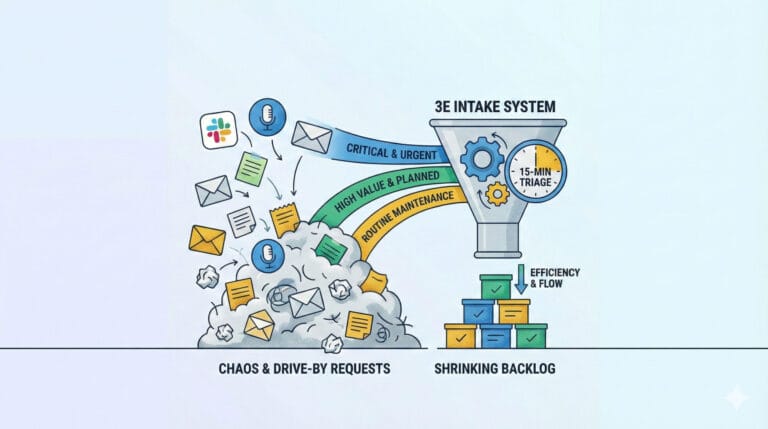

Most teams stay busy without making real progress.
Requests arrive from every direction. Slack messages. Urgent emails. Hallway conversations. Everything feels important, so everything gets logged.
The backlog grows.
Your backlog is not a roadmap. It is a dumping ground.
This creates misalignment across all three experiences. Users see lingering bugs. Content teams escalate concerns directly to developers. Engineers lose focus switching between unrelated tasks.
A structured intake system changes this.
The Real Cost of Unstructured Intake
When requests flow through informal channels, three problems emerge.
Audience Experience suffers. Critical issues sit unresolved while teams chase urgent but low-value work. Trust erodes when the same problems persist.
Creator Experience breaks down. Content and product teams bypass the system because they believe direct requests move faster. This creates friction and inconsistent prioritization.
Developer Experience deteriorates. Context switching damages focus. Research shows it takes over 20 minutes to regain deep concentration after an interruption. Unstructured intake does not just slow teams down. It increases burnout.
The solution is not working harder. It is working with clarity.
How the Three-Lane System Works
Think of intake like an emergency room. Not every patient needs immediate surgery.
The three-lane system creates clear criteria for every request.
Lane 1: Critical and Urgent
Reserve this lane for genuine emergencies.
Site-down events. Critical bugs that block essential user tasks. Revenue-impacting issues.
Ask one question: Is the business losing money right now?
Only about 10% of your work should qualify as critical. If everything feels urgent, nothing is.
Lane 2: High Value and Planned
This lane holds strategic work that aligns with business goals.
Features that drive revenue. Platform improvements that reduce long-term friction. Projects with clear business outcomes.
This is where momentum builds.
Lane 3: Routine Maintenance
Smaller fixes. Quality of life updates. Technical debt that does not block progress.
Allocate about 15% of weekly capacity to this lane. It maintains platform health without derailing strategic work.
The Weekly Triage Meeting
Structure requires discipline.
Hold a 15-minute weekly triage meeting. Review every new request. Assign each one to the appropriate lane.
This rapid sorting prevents chaos from returning.
Implement one rule: No ticket, no work.
If a request comes through Slack or email instead of your intake system, it does not get prioritized. This sounds rigid, but it creates clarity. Teams learn the process works when they use it.
What Success Looks Like
Two changes signal your system is working.
Cycle time improves. Work flows through the system faster. Teams spend less time deciding what to do next.
Unplanned work drops. Instead of dedicating 40% of every sprint to firefighting, this number falls to 10% or less. Delivery becomes predictable. Stakeholders gain confidence. Teams regain focus.
The Alignment Benefit
A structured intake process aligns the three experiences.
Audience Experience improves because critical issues get resolved predictably.
Creator Experience improves because teams understand how requests get prioritized.
Developer Experience improves because engineers work with focus instead of constant interruptions.
Clarity reduces friction. Systems support stability.
Where to Start
If your backlog feels unmanageable, simplify your intake process.
Define your three lanes. Run a weekly triage meeting. Enforce the rule that work enters through the system.
Small changes create momentum.
What part of your workflow needs this kind of clarity?