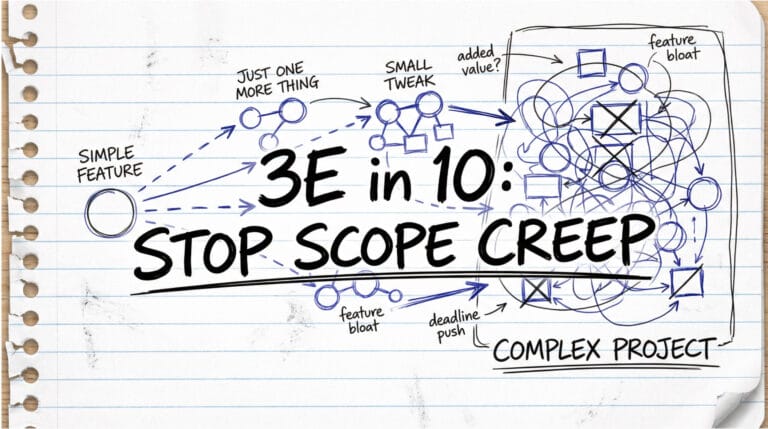

Scope creep is one of the most common reasons projects miss deadlines. It happens quietly. A small request here, a simple enhancement there. Two weeks later, your team is working on features no one asked for. The original goal gets lost, deadlines slip, and teams feel frustrated.
This guide shows you how to stop scope creep before it starts.
What Is Scope Creep?
Scope creep happens when a project grows beyond its original plan. It usually begins with reasonable suggestions. Someone says, “While we’re at it, could we also add this?” Another person suggests a small tweak. Each request seems minor on its own, but together, they add up to a much bigger project.
What started as one clear feature becomes three half-finished ones. The timeline stretches, priorities blur, and teams lose momentum.
The Real Cost of Scope Creep
Scope creep hurts everyone involved in different ways.
Your audience loses. They get features late and incomplete. Instead of one useful feature that solves a real problem, they get several that barely work. The value you intended to deliver gets diluted.
Your team loses. Unclear expectations create frustration. People prepare for launches that keep changing. Marketing drafts announcements for features that get pushed back. Support teams train on workflows that shift mid-project.
Your developers lose. Constant changes mean constant rework. This breaks trust in planning and slows everything down. When requirements change weekly, teams stop believing in roadmaps entirely.
When a project keeps expanding without boundaries, nobody wins.
Five Ways to Stop Scope Creep
The key to preventing scope creep is establishing clarity from the start. Here are five practical steps that work.
1. State One Clear Goal
Every project needs one specific goal that everyone can remember. Not three goals or five priorities. One goal that drives every decision.
A good goal is specific and measurable: “Reduce cart abandonment by 15%.” A bad goal tries to do everything: “Improve the checkout experience and update the design and add new features.”
Write your goal where everyone can see it. Put it in your project brief, reference it in meetings, and make it the first thing stakeholders see. When someone suggests a new feature mid-project, ask one simple question: “Does this help us reduce cart abandonment by 15%?” If it does not, it waits for the next project.
2. Define Your Constraints
Constraints keep projects focused by creating clear boundaries. They can be time-based, resource-based, or technical.
A time constraint might be: “This must launch before Black Friday.” A resource constraint could be: “We have two developers and one designer available for six weeks.” A technical constraint might state: “We cannot change the payment provider during this project.”
Write these constraints in your project brief and share them with stakeholders early. When someone asks for additional features, point to the constraints and explain what would need to change to accommodate the request. This shifts the conversation from “Can we add this?” to “What are we willing to sacrifice to add this?”
3. List Your Non-Goals
Being clear about what your project will not do stops feature creep before it starts. Non-goals set boundaries and prevent mission drift.
For a checkout improvement project, your non-goals might include: not redesigning the entire payment process, not adding new payment methods, not changing the product page layout, and not building a new rewards program.
Non-goals protect your focus and give you permission to say no without feeling difficult. When you share your non-goals with stakeholders, you prevent assumptions and misaligned expectations. People appreciate knowing what is out of scope just as much as knowing what is in scope.
4. Force Trade-Offs Early
Every project involves trade-offs between speed and features, simplicity and complexity, quality and quantity. The mistake most teams make is avoiding these conversations until they are forced to have them halfway through a project.
Make trade-off decisions at the beginning instead. Ask your team: “Do we ship on time with three strong features, or delay two weeks for five features?” Document the answer in your project brief.
When new ideas come up later, refer back to this decision. Say something like: “We agreed to prioritize speed over feature count. Adding this would delay our launch by two weeks. Are we willing to change that trade-off?” This forces honest conversations about priorities rather than letting scope expand silently.
5. Keep a Decision Log
Recording what you decide and why prevents the same conversation from happening multiple times. Your decision log should include the date, what was proposed, what was decided, and the reasoning behind the decision.
Here is an example entry: “October 15: Proposed adding guest checkout. Decided to defer until Q1. Reason: Our goal is reducing cart abandonment for logged-in users. Guest checkout is a separate project with different technical requirements and a different audience.”
This simple practice saves time and reduces frustration. It also shows respect for everyone’s input. People are more likely to accept “no” when they understand the reasoning and know their idea was documented rather than dismissed.
How to Use These in Practice
Start your next project with a 30-minute planning session. Work through these five steps with your team: write one clear goal, list your constraints, define your non-goals, decide your trade-offs, and set up your decision log.
Keep this document visible and accessible. Link to it in Slack, reference it in meetings, and update it when decisions change. When someone suggests a new feature mid-project, use this framework to evaluate it. Does it support the stated goal? Does it fit within the constraints? Is it on the non-goals list? Does it align with the trade-off decisions? Have you already discussed and logged this?
Most scope creep happens because teams skip this clarity step at the beginning. They assume everyone understands the boundaries, but assumptions create gaps where scope creep thrives.
Building a Culture of Clarity
Preventing scope creep is not about saying no to good ideas. It is about protecting the original goal so you can actually finish something valuable. Good ideas will always emerge during a project. The question is not whether to consider them, but when and how.
When your team starts with clarity, you create better outcomes. Clear goals keep everyone aligned. Defined constraints prevent overreach. Non-goals protect your focus. Trade-off decisions guide your choices. Decision logs prevent confusion and wasted conversations.
These practices strengthen how your team works together. They align what your audience needs, what your team can deliver, and how your developers can build it. Start every project with one clear goal, define your constraints and non-goals, make trade-off decisions early, and document what you decide.
When you build these habits, your projects stay on track. Your team works with confidence. Your audience gets what they need.