
In software development, the word “done” sounds simple. It is not.
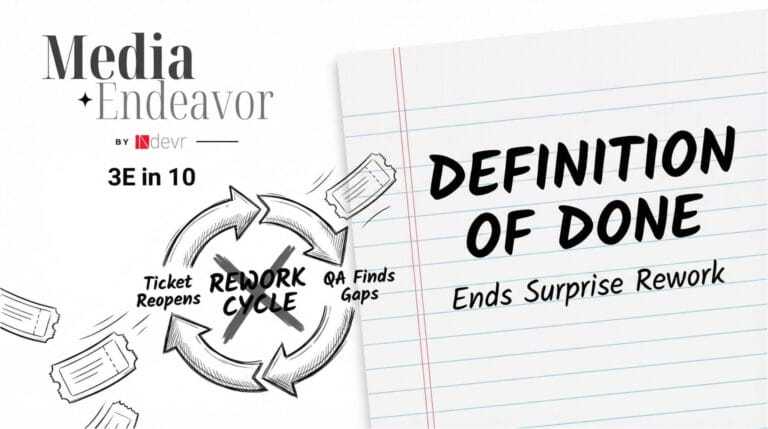
A developer finishes a feature and marks it complete. The ticket moves to QA. The tester finds gaps, missing edge cases, and loose ends. The ticket reopens. The cycle repeats.
This is not a quality problem. It is a clarity problem.
Developers, testers, and product managers each carry a different meaning of “done” in their heads. Without alignment, the gap between those meanings becomes rework.
Why One Definition Is Not Enough
A bug fix is not the same as a new feature. A speed upgrade is not the same as a content tool update.
Each type of work carries different standards for completion. When teams apply one generic checklist to everything, the result is easy to predict. Developers assume passing unit tests is enough. Product managers expect deeper testing and edge case coverage. Neither is wrong. They are just not aligned.
That gap is where rework begins.
How to Build Clarity Into the Process
Define done by work type.
Start by naming the types of work your team handles. Bug fixes, new features, content tools, speed improvements. Each one should have its own definition of done.
For a bug fix, that might include finding the root cause, writing the fix, and running follow-up tests. For a new feature, it might include meeting the criteria, passing unit tests, and checking that it works on mobile.
When the definition matches the work, the team knows what to expect.
Embed the definition into tickets and pull requests.
Make the checklist visible. Every ticket should include a completion list tied to its work type. Pull request templates should ask for proof that the right standards have been met.
This removes guesswork for developers and reviewers. It also creates a shared reference point for the entire team.
Review reopened tickets monthly.
Even with clear rules, some work will reopen. That is expected. What matters is knowing why.
Was the definition unclear? Were steps skipped? Did the scope shift without updating the criteria?
A monthly review of reopened tickets shows patterns. Patterns show where the process needs attention.
Make it a team agreement.
The definition of done works best when the team builds it together. Developers, designers, product managers, and QA should all have a voice.
Write it down. Review it often. Keep it current as the work changes.

What Changes When Done Is Clear
Reopened tickets go down. Features ship complete the first time. Developers spend more time building and less time fixing.
Product managers gain trust in the process. Users get a better product.
The change is not dramatic. It is steady. And it adds up over time.
A clear definition of done is not overhead. It is one of the simplest ways to reduce friction between teams and improve how work ships.