
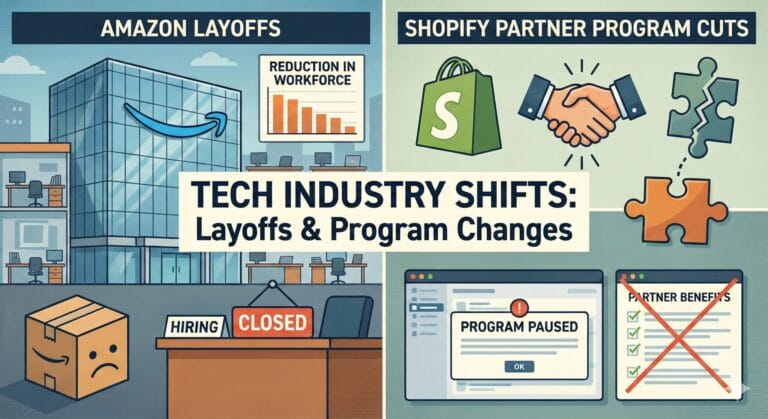

Last Tuesday, Shopify eliminated their entire partnerships division. Partner managers, ecosystem leads, developer relations — the whole agency support team, gone.
Here’s what makes this particularly striking: Shopify paid out more than $1 billion to partners in 2025 alone. Partners are generating more revenue than ever. The partnership ecosystem is critical to their business model.
But the people who support those partners? Eliminated.
And this isn’t just Shopify. It’s a pattern we’re seeing across platforms — one that outdoor brands building e-commerce businesses need to understand.
The Numbers Tell Two Different Stories
Story One: Partner Teams Are Getting Cut
Shopify’s pattern over the past year tells a clear story:
- June 2025: Sales team fired following internal fraud investigation
- November 2025: Approximately 80 roles cut across merchant success, operations, and sales
- January 2026: Entire partnerships division restructured, including elimination of agency team
Less than three months between the November cuts and this week’s restructuring. Employees report a pattern of finding out via “grey Slack profiles” — discovering colleagues were let go when their accounts were deactivated.
In April 2025, CEO Tobi Lütke made AI usage “a baseline expectation” for all employees. Workers had to demonstrate why AI couldn’t help them before requesting additional resources or staff. The message was clear: if AI can theoretically do your job, you need to justify your existence.
This isn’t unique to Shopify. Across the tech sector in 2025, 127,000 U.S. workers were laid off, with AI cited as the cause for 55,000 of those cuts.
Story Two: Partner Revenue Is Growing
Meanwhile, the data on partner ecosystems tells a completely different story:
- Microsoft: 95% of commercial revenue flows through partners
- Salesforce: 70% of revenue comes from partners
- Autodesk: 65% of revenue attributed to partners
- Overall SaaS market: Partners account for 38.2% of application revenue
The SaaS market itself is growing from $215 billion in 2023 to $278 billion in 2024 — 30% year-over-year growth. Partner ecosystems are driving this expansion. Cloud marketplaces alone are forecasted to exceed $45 billion by 2025.
Perhaps most tellingly: when surveyed about 2026 partnership investment, zero B2B SaaS companies said their investment in partnerships was decreasing.
Partners generate more revenue. Partner ecosystems are strategic priorities. But partner people are being eliminated.
What’s actually happening here?
Four Theories on Why This Is Happening
Theory 1: The Self-Service Bet
Platforms are fundamentally reimagining how they support partners.
The old model:
- Partner manager assigned to your agency
- Regular check-ins and dedicated support
- Human troubleshoots integration issues
- Relationship-based partnership
The new model:
- Partner portal with comprehensive documentation
- AI chatbot for support questions
- Community forums for troubleshooting
- Platform-based partnership
Platforms are betting they can serve 10x more partners with 1/10th the team through automation and self-service tools. For straightforward integrations and common issues, this might work. But what happens when something complex breaks and you need someone who actually understands your specific situation?
Theory 2: AI Productivity Expectations
Shopify’s logic appears to be: if one partner manager using AI tools can handle 50 partnerships instead of 10, why employ five partner managers? Replace humans with AI-augmented humans doing 5x the work.
This productivity multiplier sounds compelling in a boardroom. In practice, it means fewer people handling more partners with less context about each relationship. When you’re partner number 47 of 50, how much personalized support are you really getting?
Theory 3: Strategic Reallocation
Follow the money and you see platforms cutting relationship roles while investing heavily in product and AI development:
- Shopify: Cutting partnerships team while investing in “agentic commerce” (AI agents that can shop autonomously)
- Meta: Reducing Reality Labs by 10% while doubling down on AI research
- Amazon: 30,000 corporate cuts while spending $125 billion on capital expenditures for 2026
The strategic message is clear: reallocate from “helping partners succeed” to “building the next thing” and assume partners will figure it out.
Theory 4: Post-Pandemic Correction
IBM’s CEO called it a “natural correction.” Companies “gorged on employment” during the pandemic digital boom and are now on a strict diet:
- 2020-2021: Massive hiring to meet pandemic digital demand
- 2022-2023: Major layoffs (Shopify cut 10%, then 20% of workforce)
- 2024-2025: “Removing complexity” and management layers
- 2026: Getting efficient before potential recession
This correction is now reaching partner-facing teams that were considered untouchable just a year ago.
What This Means for Outdoor Brands
If you’re building your e-commerce business on Shopify — or BigCommerce, or any platform — here are the immediate questions you should be asking:
When Your Agency Hits a Platform Issue, Who Do They Call?
Your agency used to have a partner manager they could contact when integrations broke or API changes caused problems. That person might not exist anymore.
Shopify just implemented major API changes effective January 2026. Custom apps need migration. Access rules are tightening. Integrations that work today might break tomorrow. And the team that used to help navigate these changes? Gone.
This doesn’t mean your agency can’t figure it out. Good agencies will. But the environment they’re working in just fundamentally changed.
What Does “Partner Program” Actually Mean Now?
Don’t assume “partner program” means “dedicated support.” Test what support actually looks like:
- Join the partner forums and observe response times
- Submit a test support ticket and see what happens
- Talk to other partners about their recent experiences
- Ask your agency directly: “When something breaks, what’s your backup plan?”
The gap between what you think you’re getting and what actually exists might be larger than you realize.
Are You Building Platform-Agnostic Capabilities?
Smart brands are investing in internal expertise that doesn’t depend on platform hand-holding:
Technical capability: Your team (or your agency’s team) understands APIs, webhooks, and integrations at a fundamental level — not just platform-specific implementations.
Documentation literacy: Can your team read technical documentation and troubleshoot independently, or are they dependent on having someone walk them through it?
Platform flexibility: Are you “all in” on one platform’s ecosystem, or do you have the ability to move if constraints become too tight?
This isn’t about avoiding platforms. It’s about understanding your dependencies and building capabilities accordingly.
The 2026 Reality: Capability Over Relationships
Here’s what’s actually happening:
Platforms realize partners are critical to their business model. The revenue numbers prove it. But they’re also realizing they can serve those partners with far fewer humans through self-service tools, AI chatbots, community forums, and better documentation.
The bet is simple: “Our best partners will figure it out. And the ones who can’t? They weren’t going to scale with us anyway.”
That might be true. But it fundamentally changes the game for who succeeds on these platforms.
In 2020: If you had a good relationship with your partner manager, you could succeed on a platform.
In 2026: If you have strong technical capabilities and can navigate platform complexity independently, you can succeed on a platform.
The question for outdoor brands: Which side of that line are you on?
What To Do About It
This isn’t “abandon all platforms” advice. Platforms serve real purposes and aren’t going anywhere. But you need clear eyes about what support actually looks like in 2026.
Audit Your Dependencies
Map out exactly where your business depends on platform support:
- Which integrations are critical to operations?
- Where does your team (or agency) typically need help?
- What happens if those support channels disappear?
- Do you have direct access to documentation and tools?
Invest Strategically in Capability
Decide whether to build internal expertise or ensure your agency has it:
- Can your team troubleshoot platform issues independently?
- Do they understand the underlying technology, not just the platform interface?
- When API changes happen, can they adapt without extensive external support?
This might mean hiring differently, training existing team members, or being more selective about agency partners who have deep technical chops rather than just strong relationships.
Evaluate Platform Support Realistically
Before committing to a platform (or recommitting during a migration), test support before you need it:
- Submit actual support tickets and measure response quality
- Join partner communities and assess engagement levels
- Talk to other brands about their experience
- Don’t assume the glossy partner program materials reflect reality
The platforms with the most human support are probably the ones charging the most. WordPress VIP and Salesforce Commerce Cloud offer white-glove support — but you’re paying premium prices for it. SMB e-commerce platforms competing on price? Self-service is the future.
Consider Platform Flexibility
This doesn’t mean you need to be platform-agnostic on day one. But ask yourself:
- If our platform’s constraints become too tight, could we migrate?
- Do we own our data and have access to it?
- Are we building on the platform or building into the platform?
- What’s our exit strategy if this relationship doesn’t work?
Headless commerce architectures give you more flexibility. WordPress-based solutions give you more control. Fully-managed SaaS platforms give you less of both — but might offer other benefits. Just understand the tradeoffs you’re making.
The Bottom Line
Partner ecosystems aren’t going away. The revenue numbers prove they’re more important than ever to platform businesses. But the way platforms support those partners is fundamentally changing.
Self-service is replacing high-touch relationships. AI chatbots are replacing partner managers. Documentation is replacing hand-holding. And the platforms are betting their best partners will not only adapt but thrive under this model.
They might be right. The partners who succeed in 2026 will be the ones with strong technical capabilities, platform-agnostic skills, and the ability to navigate complexity independently.
The question isn’t whether your platform is “good” or “bad.” The question is whether your team — internal or agency — has the capabilities to succeed in this new environment.
Because the hand-holders just got laid off. And they’re not coming back.